
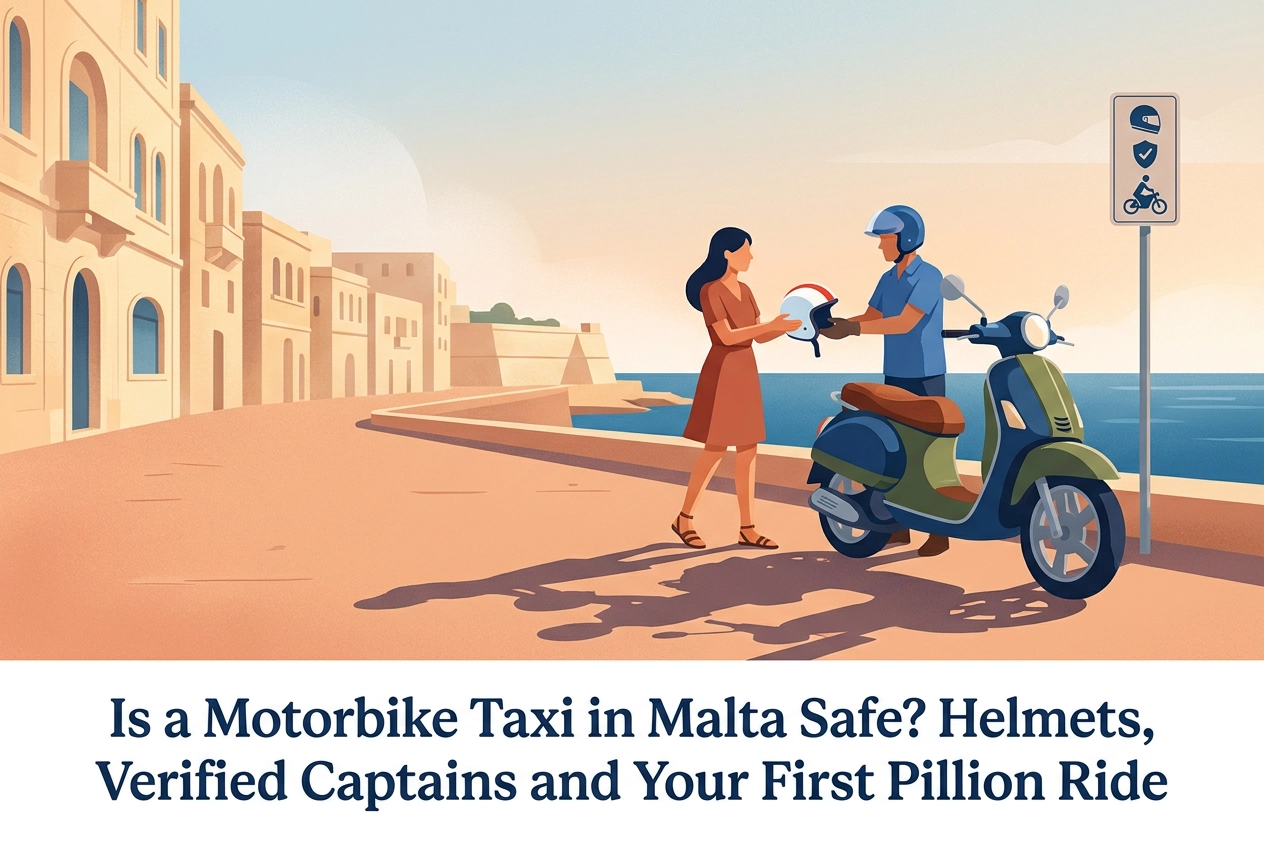
If your first thought about a motorbike taxi in Malta is not "how fast" but "I'd be sitting on the back of a bike in Malta traffic," you are asking the right question. This guide treats that concern seriously. It does not rely on reassurance. It explains the system that sits around a pillion ride: who is driving, how that Captain is verified, what you wear, and how your destination and price are fixed before the bike moves. It also covers why no delivery detours means no surprises. You will learn what Malta's road data does and does not say, why helmets for every passenger matter most here, and how to handle your first pillion ride step by step. We will walk through passenger checks before you set off and the questions beginners ask. By the end, a short motorbike taxi hop in Malta should look less like a dare and more like a reasonable, structured choice.

Is a Motorbike Taxi in Malta Safe? The Short Answer
Yes. A short pillion trip can be a reasonable choice in Malta when safety is settled before the bike moves, not promised after it stops. Three things must be fixed before departure: who is driving, what you are wearing, and exactly where you are going and what it costs. This guide treats safety as a process with named steps. It makes no claim that a motorcycle is risk free. It also states plainly what the evidence lacks: no publicly available Malta-specific breakdown of pillion passenger or motorbike taxi crash data was found in the searched sources, including the NSO road transport portal and Transport Malta's public transport pages, so no figure of that kind appears here. What follows first covers Malta's road safety context, then the pre-ride system, then a step-by-step walkthrough of your first pillion ride and what to check as a passenger.

The Objection You Never Type: Sitting on the Back of a Bike in Malta Traffic
You have probably already thought it, without typing it: "I would be sitting on the back of a bike in Malta traffic." That is not irrational. It is location-specific. The EC National Road Safety Profile describes Malta's road infrastructure as having very high road density, with quality perceived as very low compared with other EU countries. The same profile reports a relatively high proportion of powered two-wheeler fatalities and of fatalities on urban roads, which is precisely the environment a short pillion hop occupies. Telling you it is fine changes none of that. Reassurance does not alter who is driving, what you are wearing, or how the trip is structured. So treat the objection as an engineering question you can audit: what is verifiable before departure, and what is left to chance? That is the framing that Malta moves better on two wheels should be judged by, and everything below is that audit.
What Malta's Road Data Does and Does Not Say
Malta's aggregate record is comparatively strong. The EC National Road Safety Profile for Malta, using 2019 data published in 2021, reports 16 road deaths, 32 fatalities per million inhabitants against an EU average of 51, and 0.41 per 10,000 registered vehicles against 0.88. On that dataset Malta ranked 3rd of 27 EU countries, so the country is not an aggregate outlier of danger.
The same dataset carries a counterweight. Fatalities fluctuated between 9 in 2012 and 23 in 2016 with no clear trend, and serious injuries rose 55 percent, from 204 to 317, between 2010 and 2019. EU fatalities fell 23 percent over the same period (29,611 to 22,700), a decline Malta's rate did not mirror.
Two boundaries matter. First, the profile reports a relatively high share of powered two-wheeler and urban-road fatalities, the environment a short pillion hop occupies. Second, no source in this research measures pillion passenger or motorcycle taxi safety in Malta. These figures set context, not a verdict.
Global numbers are dated because they describe other roads. WHO's finding that nearly half of road deaths are vulnerable road users comes from its 2009 Global Status Report. NHTSA's 6,228 motorcyclist deaths are from 2024 and are American, not Maltese.
Who Is Driving: How a Verified Captain Is Checked
Malta's figures set the context; the next question is who is actually holding the handlebars. On RapidoRides, "verified Captain" is a product mechanic, a described process, not a sourced statistic. No verification rate or identity-check figure is published, so treat it as a process claim rather than a measured outcome.
What the check covers: identity confirmed, licence and eligibility to carry passengers checked before the account can accept a ride. Carrying a passenger in Malta is a licensed activity, not an open one, which is why operators apply for an SOV operator licence through Transport Malta.
That changes the risk conversation. You are not accepting an unknown rider; you are accepting a checked account attached to a traceable trip with your name and destination on it. RapidoRides is rides only, so every trip carries a passenger and a destination, never a parcel.
Proportion matters: verification narrows who can be behind the handlebar. It does not empty the road or remove traffic.
A Helmet for Every Passenger, and Why That Matters Most in Malta
The helmet settles what you are wearing once the bike moves, and in Malta that is the clearest rule in the system. The EC National Road Safety Profile states that, except for motorcycle helmet legislation, enforcement in Malta is less widely perceived as effective than in other EU countries. Helmet use is therefore the best established, most consistently enforced requirement a pillion passenger will meet.
The mechanic is plain: a helmet that fits is part of the ride, supplied by the Captain, not equipment you are expected to source beforehand. For a first pillion ride this matters most, because most passengers do not own a motorcycle helmet. Without it, you would be guessing at size and strap fit at the kerbside.
NHTSA treats helmet use and rider visibility as core safety behaviours. The same logic applies to the person on the back. No helmet effectiveness percentage is quoted here; the mechanic, not a risk figure, is the claim.
Destination and Price Fixed Before You Ride
With the helmet sorted, the next thing fixed is where you are going and what it costs. In the app you enter your destination and see a fixed price before you request the ride, so the route and the fare are settled while the bike is still stationary.
Here is first-principles reasoning, not a research finding: when destination and price are agreed in advance, there is nothing left to negotiate mid-trip, and no reason for the route to change. That makes it a safety property, not just a billing convenience. A predictable journey length means fewer unplanned turns and no argument at the kerb.
Payment stays equally plain. You pay by cash or card at the price you saw, with no meter running and no surprise fare on arrival.
Be clear about the evidence: no source in this research tests fixed pricing as a safety mechanism. Treat this as product design logic, not a measured outcome. Next, why a rides-only model removes a further category of surprise.
No Delivery Detours, No Surprises
Here is the operating model in one sentence: RapidoRides carries passengers, and only passengers. There is no delivery queue attached to your booking, because the app does not take delivery requests at all.
On a passenger-only service, expectations shaped by mixed-use platforms simply do not apply: as covered in the Captain verification section, every trip has one purpose and one destination. That is product-design logic rather than a measured finding: a detour adds time in traffic, an unfamiliar turn and an extra stop, none of which you agreed to when you accepted the fixed price.
Be clear about the boundary. This removes a whole category of surprise from the ride. It does not remove traffic, and it does not make Maltese roads quiet. Those conditions exist whatever vehicle you are in.
Your First Pillion Ride, Step by Step
With the trip itself settled, here is exactly how your first pillion ride unfolds.
Booking. Open the app, enter your destination and read the fixed price. Confirm only when you are ready, so nothing is committed before you accept.
Captain arrival and check in. The verified Captain arrives with your helmet. Confirm you are the passenger on the trip, and ask anything you want before the bike moves.
Helmet and fit. Put the helmet on before departure and fasten the strap. If it does not feel snug, ask the Captain to help adjust it.
Route and price confirmation. Check that the destination and price on your own screen match what you agreed. Treat this moment as your final go or no go decision.
The ride. Hold the rear grab rail or the Captain's waist as directed, keep both feet on the pegs, lean with the bike rather than against it, and stay still at low speed.
Arrival and payment. Pay by cash or card at the fixed price. No negotiation, no meter, and no additional stop along the way.
Those six moments are the whole system. The short checklist for auditing it yourself comes next.

What to Check as a Passenger Before You Set Off
The steps are done. What remains is your own sixty-second audit, while the bike is still stationary.
Cross-check your screen once more: the destination and the fixed price you agreed must match what the Captain has. If they differ, do not set off.
Helmet: it should sit snug and level, with the strap fastened under the chin. If it lifts or rattles when you turn your head, speak up immediately rather than hoping it settles once you move.
As covered in the step-by-step section, tell the Captain it is your first pillion ride so they can brief you on the grab rail, foot pegs and lean.
Empty your hands. Phone, keys and wallet go in a zipped pocket or a closed bag, so nothing needs holding while you are moving.
You also hold the exit. If anything feels wrong, ask the Captain to pull over at a safe point. You are never committed to continuing a trip that does not feel right.
Questions Passengers Ask Before a First Pillion Ride
Is it safe if I have never been on a motorbike before?
The mechanics exist for the first timer: helmet, briefing, agreed route and fixed price apply whether you ride daily or never have. The pillion seat is designed and legal: under the UK Highway Code (Rule 85) and the equivalent principle in most European jurisdictions, the pillion seat, footrests and forward-facing stance are a legal requirement, not an operator preference; Malta's own equivalent is set by Motor Vehicles Regulations SL 65.11. Sit astride, feet on the footrests.
Do I need my own helmet?
No. A helmet is provided for every passenger, fastened before you move. Most passengers do not own one, so fit is the Captain's job, not your guesswork.
What if the traffic is heavy?
Short urban hops sit in the most contested space in Malta's own road data, and no bike taxi removes traffic. As covered in the detours section, a passenger-only trip means your fixed destination is where the ride goes, with no delivery stop added along the way.
Can I pay how I like?
Yes. Cash or card, at the price you saw before the ride, with no meter and no surprise fare on arrival.
What happens if I change my mind?
You can ask the Captain to stop at any safe point. Nothing is charged beyond the agreed fare.
A Reasonable Choice, Not a Dare
If those answers leave one question standing, it is this: is a short pillion hop a dare or a reasonable choice? It is reasonable when the safety is settled before the bike moves, not promised after it stops.
Three mechanics are yours to audit: a verified Captain, a helmet fitted for every passenger, and a destination and fixed price agreed before departure.
As the road data in the earlier section shows, Malta's aggregate fatality record is comparatively strong, yet powered two-wheeler and urban-road fatalities are over-represented in that same dataset, so the context stays honest.
RapidoRides is launching in Malta with fixed prices, a helmet for every passenger and no delivery detours. The waitlist is open at rapidorides.com.
Conclusion
The three pre-departure checks covered throughout this guide, a verified Captain, a fitted helmet and a fixed destination and price, are the audit that turns a pillion hop from a dare into a structured choice. If you want that first ride to feel planned rather than daring, join the waitlist at rapidorides.com.