
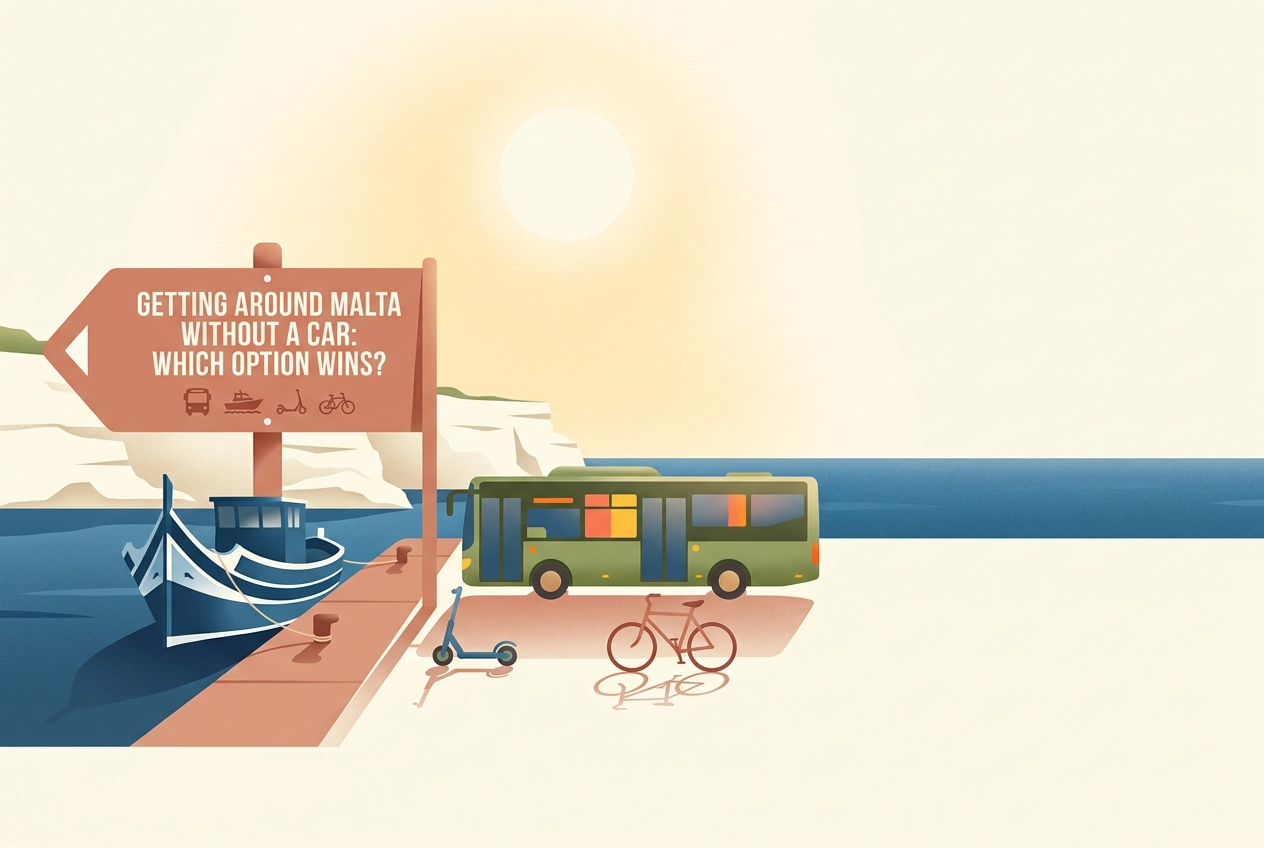
Malta looks tiny on a map, so it is easy to assume a car is the only sane way to cross it. Then you hit rush hour near the southeast corner, circle a block for parking, and realize the island's size does not automatically make every trip quick or simple. That is why this post compares the realistic options for getting around Malta without a car, from buses and walking to taxis and motorbike taxis, on the things that actually decide your day: door-to-door time on a 3 to 5 km trip, where you park or lock up, whether you can know the cost before you commit, and what is still running at 11pm. You will see why the bus wins on price but often loses on time, why walking is defeated by time, and why the car should stop being the default for short hops. We will also look at Malta's terminal-and-corridor bus network, the 5 to 6pm southeast traffic problem, and the verdict on which trips actually change. By the end, you will have a clearer rule for choosing your next short trip.
Why Malta Makes the Car the Reflex, and Why It Should Not Be
Here's the claim up front: most daily trips on the main island are short, nearly half were recorded as intrazonal in the 2021 National Household Travel Survey, and a car is only the default because it is a reflex, not because it is fastest.
That reflex survives on the idea that distance equals time. In Malta, it does not. Your time budget is spent on traffic, hunting for a parking space and the walk at both ends, not on the kilometres.
There is one honest exception: the southeast corner of the main island at rush hour, around 5 to 6pm, where the gap between one bus stop and the next can stretch to 10 to 15 minutes, and you sit in that same traffic whether you are driving, ride-hailing or on the bus. Our guide to taxi apps in Malta covers how those options compare.
What Your No-Car Options Actually Are in Malta

Malta's bus network is anchored on four terminals: Valletta, Buġibba, Ċirkewwa and Victoria in Gozo. That terminal-and-corridor shape tells you it's engineered for trunk movements, not short cross-town hops, which is why some brief trips feel underserved despite how close everything looks on a map.
It isn't static either. Alongside core routes, the operator runs Airport Direct, tallinja Direct for quick cross-island links, Gozo High Speed, the Valletta Ferry to Sliema and the Three Cities, on-demand night services, and tallinja Bike rentals from docking stations for a quick short ride.
Cost is the bus's strongest card: around €15 buys 12 single-day journeys, roughly €1.25 each, with a 7-day Explore Card for longer stays and free Wi-Fi on every bus. Verify current single fares on the operator's fares page before you rely on that figure, since it currently rests on a single editorial source.
Cycling works on flat, short coastal runs, but the road network's physical constraints, narrow carriageways and limited junctions noted in Malta's own transport policy, limit it in practice. Walking genuinely works inside compact Valletta, where distances are minimal and the ferry links to Sliema are an easy addition.
Then there's the third layer: ride-hailing already operates here, and RapidoRides is bringing a fixed-price motorbike taxi to Malta in 2027, aimed at the short, awkward trips where Malta moves better on two wheels.
Dimension 1: Door-to-Door Time on a 3 to 5 km Trip

Door-to-door means leaving your building to arriving at your destination: the walk to the stop or parking space, the wait, the ride, then the walk at the far end. Distance tells you almost nothing; elapsed time decides. And 21% of respondents told the National Household Travel Survey that walking takes too long.
Bus. On a 3 to 5 km hop the ride is brief. The total is not. You walk to a stop that sits on a corridor, wait, possibly change at a terminal, and at the 5 to 6pm peak in the southeast, waits between stops can stretch to 10 to 15 minutes, as noted above. A trivial distance can still lose.
Bicycle. On flat, short, daytime runs a bike beats both, because it starts and ends at your door with no wait. Hills and summer heat undo that unless you can change at the other end.
Motorbike taxi. Different in kind, not just faster: no parking search, no walk to a stop. A Captain comes to you and drops you at the destination, which makes it strongest for trips too far to walk and too awkward for a bus corridor.
Build your own budget: walk, wait, ride, final walk. Per-route timings should be documented in a clearly labelled walkthrough before publication, with rush-hour claims tied to 5 to 6pm.
Dimension 2: Where You Park or Lock Up
Parking is the hidden cost of the short trip: on a short drive into a town centre, the parking search can rival the drive itself in time, especially in Valletta, where a University of Malta study found demand exceeds supply and commuters hold most available spaces (University of Malta research). Check current supply and tariff figures with NSO and Transport Malta before quoting any number.
Bus: no parking problem, but the stop becomes the friction. You still walk to it, and inside Valletta and other compact centres the walk from the stop to your actual destination is a real part of the journey.
Bicycle: lock-up, not the ride, is the weak point. Ask whether there is secure parking at both ends, whether a tallinja Bike docking point sits near your start and finish, and whether you are happy leaving the bike there all evening. Cycling infrastructure and lock-up norms need sourcing before specific claims.
Motorbike taxi: nothing to park, nothing to lock. You are a passenger, so the parking question disappears entirely, which is exactly why this mode suits trips ending in town centres where parking is scarce and expensive.
Simple rule: if your trip ends somewhere with constrained parking, weight this dimension heavily. If it ends at a station, airport or out-of-town retail park, it barely matters.

Dimension 3: Can You Know the Cost Before You Commit?
Cost certainty is the other half of the decision.
The bus remains the cheapest option, around €1.25 a journey on a €15 day-ticket bundle (verify current fares at the operator's site).
A bicycle is the cheapest marginal cost per trip if you already own or rent one, but the real spend is the purchase or rental plus theft and damage risk, a cost you carry silently rather than see at the moment of travel.
Ride-hailing and metered taxis vary with time of day and demand, so the fare at peak times may differ from what you would pay at midday, check the app or ask before confirming.
Fixed pricing changes that. RapidoRides brings fixed-price motorbike taxis to Malta in 2027, with the fare shown before the ride is confirmed, so cost stops being an estimate. The waitlist is open at rapidorides.com.
Unpredictability is what pushes people back into their own car. The car feels free even when fuel, wear and parking are not, so a price you can see in advance removes the main excuse for driving.
Dimension 4: What Is Still Running at 11pm?
Cost is knowable in advance; late-night availability is the part you assume, and it is the dimension people skip checking. Check last departures route by route rather than assuming a single island-wide pattern.
Bus. The network runs to timetables, which means late service depends entirely on your route and its corridor. Check the operator's published timetable and live service alerts for last departures. That includes the newer on-demand and direct services, whose hours also need confirming rather than assumed.
Bicycle. Technically available at any hour. In practice, riding narrow left-hand roads after dark on a small island is a comfort and safety judgement, not the easy late-night answer.
Motorbike taxi. A motorbike taxi on a demand-led model is not bound by a fixed timetable, but confirm operating hours at RapidoRides' 2027 launch before treating it as a guaranteed late-night fallback.
So if your trips regularly fall after 11pm, plan around the published timetable first. Know your fallback before you go out, and treat everything else as a backup rather than the plan.
The Verdict: Which Trips Actually Change
Bus | Bicycle | Motorbike taxi | |
|---|---|---|---|
Door-to-door time (3 to 5 km) | Ride short, total long: walk, wait, congestion | Fastest on flat daytime routes | Door to door, no parking search |
Park or lock up | Nothing to park, but you walk from the stop | Secure locking needed at both ends | Nothing to park or lock |
Cost knowable in advance | Yes, roughly EUR 1.25 a journey | Yes per trip; theft is the hidden cost | Yes, fixed price before you confirm |
Availability at 11pm | Route dependent; check last departures | Possible, but dark narrow roads are a judgement call | Not timetable-bound; hours confirmed at 2027 launch |
The bus stays default for trunk corridors, long trips, and anything where price certainty beats time. The network is not static: tallinja Direct, on-demand services, tallinja Bike and the Valletta Ferry all serve short hops alongside core routes.
The bicycle wins a narrow window: flat, short, daylight, secure lock-up at both ends. Hills and darkness close it.
That leaves the motorbike taxi as the default for the short, awkward trip a car handles by reflex: a 3 to 5 km hop to a restaurant, appointment or town centre where parking hurts and no corridor runs your way.
So stop asking car or no car. For many daily trips on a small island, a car is not necessary. Name the trip: corridor, cycling or awkward short hop.
Quick Answers to Common Questions
Is it easy to get around Malta without a car?
Yes, for most trips. Distances are short and the bus network is cheap and extensive. The friction is time and late-night coverage, not a shortage of transport options.
How much is the bus in Malta?
Around €1.25 a journey on a 12-journey day-ticket bundle; a 7-day Explore Card suits longer stays, verify current fares at the operator's site.
What is the fastest option for a short trip?
On a 3 to 5 km trip, anything that skips the walk to a stop and the hunt for a parking space wins. That points to two wheels: your own bicycle on a flat route, or a motorbike taxi when you would rather the ride came to you.
What is still running after 11pm?
Check it route by route against the operator's published timetable. A motorbike taxi on a demand-led model is not bound by a fixed timetable, but confirm operating hours at RapidoRides' 2027 launch before treating it as a guaranteed late-night fallback.
Does Malta have ride-hailing?
Yes, ride-hailing apps operate on the island. RapidoRides is adding a fixed-price motorbike taxi service, launching in Malta in 2027, and the waitlist is open at rapidorides.com.
Stop Treating the Car as the Default
The questions are out of the way, so here is how to put it into practice.
The scorecard from the comparison above applies directly here. Three things to do before you reach for the keys.
First, classify the trip. Call it a corridor trip, a cycling trip or an awkward short hop. The label does the deciding for you.
Second, check the timetable if it is after 11pm. Confirm the last departure on your route, and know the fare before you leave rather than after.
Third, run the test. For a 3 to 5 km trip into a town centre, try the no-car option once and compare it honestly with the parking reality. That single test, not an argument, is what changes the habit.
Transport Malta, established by Act XV of 2009 as the national regulator for all modes of transport, has a statutory role that includes developing integrated transport policies aimed at achieving modal shifts that favour the use of public transport. The direction of travel on the island is toward fewer car trips, not more.
RapidoRides is launching a fixed-price motorbike taxi in Malta in 2027. The waitlist is open at rapidorides.com.
Conclusion
Malta without a car is not a compromise. It is a set of better choices for the right trips. The comparison above gives each mode its window. After 11pm, check the route timetable and confirm the fare before you leave. Then run one honest test: replace a short town-centre drive with the no-car option and compare it with parking, stress and time. The goal is not to ban cars. It is to stop treating them as the default. Pick your trip, check the details, try it once. If you want a fixed-price ride that comes to you, join the waitlist at rapidorides.com.